
Webinar: Civil Resistance Against Hybrid Warfare: Ukrainian Lessons from the Frontlines
EuroISME in association with King’s Centre for Military Ethics (KCME) & School of Security Studies, King’s College London
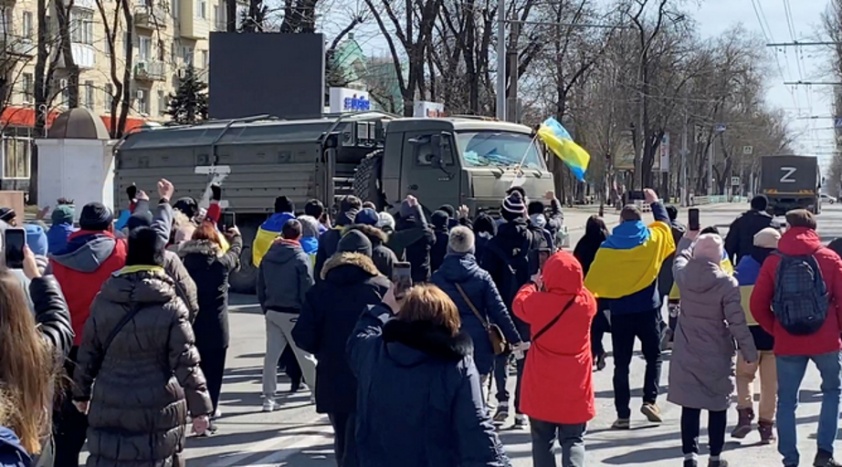
This webinar explores the evolving landscape of nonviolent civil resistance in Ukraine following Russia’s full-scale invasion. It examines the driving forces, strategic logics, and key actors behind these grassroots efforts, highlighting how civil resistance has strengthened societal resilience while countering hybrid warfare.
Bringing together leading research and frontline actors directly engaged in organising, supporting, and researching civil resistance initiatives, the session will provide first-hand insights into how these efforts have protected civilians, prevented polarisation, and constrained Russian military strategies.
Speakers will share analysis and field-based experience on resisting information warfare, responding to military occupation, countering disinformation, building communication networks, and defending critical infrastructure in the context of large-scale invasion. The discussion will also draw strategic lessons for developing effective civilian-based defence systems and for advancing constructive civil–military cooperation.
Date: 18 March 2026 at 16:00 GMT//17:00h CET//18:00h Ukraine time (90 minutes)
Chair: Dr Andrea Ellner, Senior Lecturer in Civil-Military Relations & Ethics, Defence Studies Department, King's College London, Deputy Director KCME, and co-Executive director EuroISME
Recording
To start the video, click on the preview above this line
Speakers and presentation titles
Felip Daza: The Evolution and Strategic Impact of Ukrainian Civil Resistance in Response to the 2022 Russian Invasion
Mykola Davydiuk: Countering Russian Propaganda: Ukrainian Civil Society, Nonviolent Resistance, and the Battle Against Disinformation
Denys Sukhanov: Unarmed on the Frontline: Civilian Resistance, Moral Agency, and Community Resilience under Occupation
Amber French-Griette: Institutional engagement and experiments in civilian defense: past and present
More details below
Access Microsoft Teams meeting
Join: https://teams.microsoft.com/meet/33175450415387?p=jmsWYrTZnM7j5MpRuU
Meeting ID: 331 754 504 153 87
Passcode: Df3aL6B2
More Details on the Panellists
Felip Daza
Professor of Civil Resistance at Sciences Po Paris and co-founder of the International Institute for Nonviolent Action.
Title: The Evolution and Strategic Impact of Ukrainian Civil Resistance in Response to the 2022 Russian Invasion
Abstract: The presentation will explore how civil resistance in Ukraine since 2022 has become a central pillar of national defence in the context of hybrid warfare. Based on extensive field research, it shows how mass nonviolent mobilisation helped constrain occupation, protect critical infrastructure and sustain governance during Russia’s full-scale invasion. From spontaneous protests to organised non-cooperation and community-based crisis management, Ukrainian civilians developed decentralised and resilient networks rooted in democratic identity and local self-organisation. The Ukrainian case demonstrates that effective deterrence today depends not only on military capacity, but on society’s ability to remain cohesive, adaptive and politically ungovernable to an aggressor.
Biography: Felip Daza is a professor at Sciences Po Paris and a practitioner in the field of civil resistance, human security and conflict transformation. With over two decades of experience working with UN Agencies, governments and civil society in Middle East, North Africa, Eastern Europe, and the South Caucasus. Since 2022, his work have focused on civil resistance in Ukraine, where he has published several studies on community resilience, crisis management, and hybrid warfare. Felip Daza is the author of Ukrainian Nonviolent Civil Resistance in the Face of War (ICIP, 2022), Civil Resistance in Ukraine: Exploring the Dynamics and Impacts of Social Emancipation Forces to Counter the 2022 Russian Invasion (2024), and co-author of Wagner Group Unchained in Ukraine: Military, Political and Human Rights Impact of the Wagner Group since the 2022 Invasion (Novact/ICIP, 2023). ARTICLE
Mykola Davydiuk
Political analyst and strategic communication expert; Founder of the social transformation company Factor Bureau.
Title: Countering Russian Propaganda: Ukrainian Civil Society, Nonviolent Resistance, and the Battle Against Disinformation
Abstract: This presentation examines the evolution of Russian propaganda in the context of the Russo-Ukrainian War, focusing on disinformation, military-political manipulation, and the expanding role of artificial intelligence in shaping the information environment. It analyses how these instruments operate across cognitive and digital domains to erode social cohesion and undermine democratic trust. Through empirical evidence from Ukraine, the session explores how civil society actors have developed nonviolent resistance and counter-disinformation practices under conditions of hybrid warfare. It concludes by identifying key lessons for strengthening societal resilience and integrating civilian capacities into broader democratic defense strategies.
Biography: Mykola Davydiuk is a Ukrainian political scientist, author, commentator, and media figure. He holds professional program at the Harvard Kennedy School. Davydiuk is the director of the think tank “Politics”, founder of the Forum of New Political Leaders, and the initiator of the “Boycott the Russian Market” campaign. He has written books such as How to Make Ukraine Successful and How Putin’s Propaganda Works, focusing on Ukrainian politics, information warfare, and civic resilience. Davydiuk is also known for his popular YouTube and media presence and has been ranked among Ukraine’s “Top 50 Bloggers.”
Denys Sukhanov
Civil resistance, ethical leadership, and risk management expert from Kherson.
Title: Unarmed on the Frontline: Civilian Resistance, Moral Agency, and Community Resilience under Occupation
Abstract: What does civil resistance look like when your city finds itself on the front lines on the first day of war? This intervention reflects on the lived experience of organizing humanitarian infrastructure under Russian occupation in Kherson in 2022. It explores how spontaneous volunteer initiatives evolved into structured civic resistance — providing medicine and food under occupation, publicly documenting protest, transporting aid across frontlines, and evacuating civilians through militarized checkpoints. Drawing from frontline experience, the presentation examines civilian moral agency under extreme coercion, the ethics of risk in unarmed resistance, and the transformation from emergency survival to long-term community resilience. It argues that sustainable resistance is not only about humanitarian supply chains, but about rebuilding trust networks, horizontal civic bonds, and local capacity. The Ukrainian case demonstrates that civil resistance in hybrid warfare environments operates simultaneously as humanitarian action, information resistance, and institutional shadow governance — often led by ordinary citizens who step into extraordinary responsibility.
Biography: Denys Sukhanov is a Ukrainian civic leader and social entrepreneur from Kherson. After Russia’s full-scale invasion, he became a key organizer of the largest volunteer humanitarian coordination hub in occupied Kherson, coordinating emergency medical supplies, documenting peaceful resistance, and evacuating civilians under constant risk. Following liberation, he worked with local authorities and international partners to strengthen volunteer infrastructure and frontline humanitarian operations. Since 2024, he has focused on building the strategic capacity of volunteer networks, and in 2025 founded a civic social club to foster long-term community resilience. He is currently engaged in recovery and digital transformation efforts in Kherson. You can read about Denys’ work here.
Amber French-Griette
Wartime civic resistance expert; Co-founder and President of the Organization for Nonviolent Movements (Paris)
Title: Institutional engagement and experiments in civilian defense: past and present
Abstract: World War II offers social scientists numerous unarmed resistances to study, all leaving varying yet undeniable impacts: saving Jewish lives from extermination, spreading knowledge to embolden underground resistance, slowing Nazi consolidation of control, and much more. With the horrors of WWII fresh in their minds, 1960s scholars, military strategists, pacifists, and even literary figures developed thought experiments--and a rather disastrous human experiment--in civilian defense. While the context of WWII has little in common with Russia's war of aggression today, apart from their common asymmetrical nature, some compelling historical lessons are corroborated by Ukraine's experience. This presentation, enriched with participatory research, archival research, and in-depth interviews, will consider Europe's security conundrum in light of historical experiences, experiments, and lessons, highlighting opportunities for institutional and grassroots engagement toward a wider examination of civilian defense and the power it derives, even in the context of hybrid warfare.
Biography: Amber French-Griette is a wartime civic resistance expert and nonprofit leader focused on improving unarmed civilian defense in Europe to promote security autonomy and sustainability. After 12 years with the International Center on Nonviolent Conflict, a global leader in the field of strategic nonviolent conflict education, in 2025, she co-founded the Organization for Nonviolent Movements (ONM) in France. She is President of ONM and founder and director of publication of ONM’s Across Fault Lines journal, editing its first issue on "Ukrainian Freedom: Collective Agency in National Defense” (March 2026). With 20 years of experience in research, teaching, and diverse policy, educational, and editorial roles, she has edited three journals and commissioned over 420 articles. Amber led the co-creation and delivery of the first French-language online course on civil resistance and has written more than 40 articles on nonviolent conflict and civilian defense.